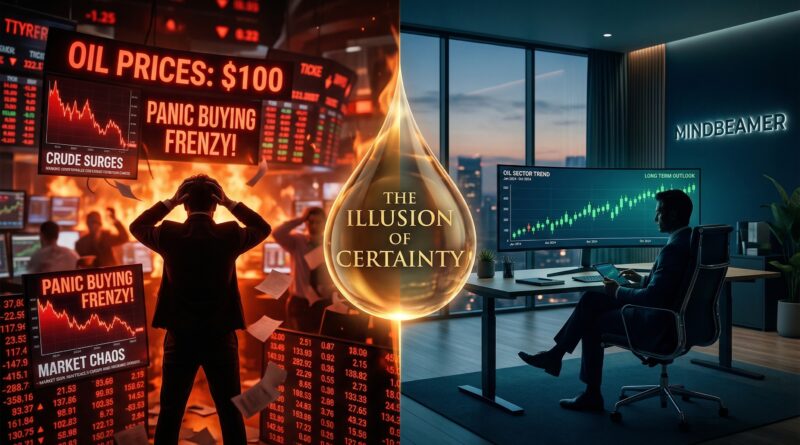
The Illusion of Certainty: Why $100 Oil Feels Like a ‘Sure Thing’ (Until It Isn’t)
In the heat of a geopolitical crisis, the global market doesn’t just trade barrels of crude oil; it trades raw human emotion.
When crude oil prices breach the psychological $100 mark, the atmosphere of the entire financial world shifts. The headlines begin to scream of $150$ or even $200$ scenarios, fueled by supply shocks and wartime uncertainty. Suddenly, buying energy assets feels like a “sure thing.” However, in the realm of financial psychology, there is no more dangerous phrase than a “sure thing.”
1. The Confirmation Bias Trap: Seeing What We Fear
When oil prices skyrocket due to conflict, our brains fall victim to Confirmation Bias. This is a cognitive shortcut where we unconsciously seek out news, “expert” tweets, and geopolitical maps that support a “perpetual rise” narrative.
We begin to ignore cooling data—such as softening demand in other sectors or hidden inventory levels—because they don’t fit the dramatic story of the moment. You start “chasing the green candles,” convinced that the trend is your friend. But history shows that the “War Premium” is often a bubble of sentiment; once the initial shock is absorbed, the price often crashes just as fast as it rose, leaving “panic buyers” at the absolute peak.
2. Recency Bias: The Enemy of Rationality
Investors often suffer from Recency Bias, believing that what happened in the last 48 hours will inevitably dictate the next 48 days. If oil jumped $90 yesterday and $110 today, our brain’s pattern-recognition software projects that line upward forever.
This leads to a complete abandonment of Mean Reversion principles. Commodities like oil are cyclical and highly sensitive to price destruction (where high prices eventually cause people to use less oil, forcing the price back down). To stay rational, an investor must separate the geopolitical event from the asset’s price action. The event may be permanent, but the price spike rarely is.
3. The Neurobiology of the Trade: Cortisol vs. Capital
Volatility doesn’t just affect your portfolio; it affects your biology. High-velocity price movements trigger the Amygdala, the brain’s “alarm system,” initiating a “Fight or Flight” response.
When your screen is flashing red and oil is hitting decade-highs, your body is flooded with cortisol and adrenaline. This chemical cocktail inhibits the prefrontal cortex—the part of your brain responsible for logical risk management and long-term planning. In this state, your brain isn’t “investing”; it is surviving. An emotional entry is rarely a profitable one. To survive a $100$ oil market, you don’t necessarily need better technical indicators; you need a more disciplined nervous system.
4. The “Parabolic” Mirage
History is littered with “sure things” that ended in tears. From the 1970s energy crisis to the 2008 spike to $145 per barrel, the pattern remains the same: a vertical move on a chart is a sign of exhaustion, not strength. When the “last buyer” has finally entered the market out of pure FOMO (Fear Of Missing Out), there is no one left to push the price higher. This is the moment the “Illusion of Certainty” shatters.
Deepen Your Financial Wisdom
To master the psychological turbulence of volatile markets and protect your capital from emotional decision-making, we recommend adding these two essential works to your library:
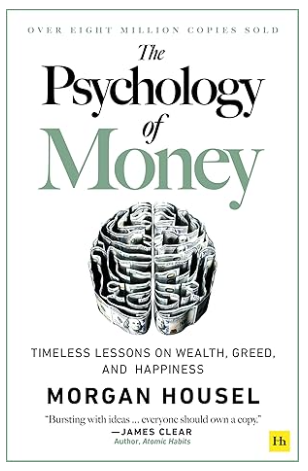
The Psychology of Money by Morgan Housel: A modern masterpiece that explains how ego, bias, and emotion dictate financial success far more than technical skills. It is essential for understanding why we feel the urge to panic.
Extraordinary Popular Delusions and the Madness of Crowds by Charles Mackay: First published in 1841, this book remains the gold standard for understanding how human beings lose their sanity in groups. It proves that the $100$ oil panic of today is just another chapter in a very old human story.