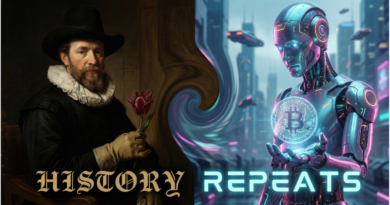
The Mathematics of Freedom: Why You Don’t Need to Be a Genius to Get Rich
If I gave you a choice right now, which would you take?
Option A: $1 million in cash, right now.
Option B: A single penny that doubles in value every day for 30 days.
Most people, driven by instinct, grab the million dollars. It feels like a fortune. But they just made a terrible mistake.
That single penny, thanks to the power of compounding, would grow to over $5.3 million by day 30.
This is the secret that Warren Buffett, the world’s greatest investor, used to build his empire. It wasn’t just stock picking skills; it was time. In this article, we will explore the “Eighth Wonder of the World” and how you can use it to build unstoppable wealth.

1. The Linear Brain vs. The Exponential World
The biggest problem with wealth building isn’t the market; it’s our brains. Humans evolved to think linearly.
- If you walk 30 steps, you travel 30 meters. That is linear.
- If you take “exponential” steps (doubling each time), by the 30th step, you would circle the Earth 26 times.
We struggle to visualize exponential growth. This is why most people quit investing early. They save for a year, see only a small profit, and think, “This isn’t working.”
But compounding is like a bamboo tree. For 5 years, you see nothing but dirt. Then, in 6 weeks, it shoots up 90 feet. Wealth strategy is boring at the beginning, but explosive at the end.
2. The Warren Buffett Secret
Warren Buffett is worth over $100 billion. But here is the crazy stat: $99 billion of that wealth was accumulated after his 50th birthday.
If Buffett had started investing at age 30 instead of age 10, and quit at age 60, you would have never heard of him. His secret ingredient wasn’t just “returns”; it was longevity.
Wealth Strategy Rule #1: Time in the market beats timing the market. You don’t need to find the “next Apple” or “next Bitcoin.” You just need to be average, consistently, for a very long time.
“Compound interest is the eighth wonder of the world. He who understands it, earns it… he who doesn’t… pays it.” — Albert Einstein
3. The Strategy: How to Start Your Snowball
So, how do we apply this? You don’t need a PhD in finance. You need a simple protocol.
Reinvest Dividends: Never take the profit out. Let the “baby money” make its own babies. This is the fuel of compounding.
Start Early (The Time Advantage): Every day you wait is a day the “doubling” doesn’t happen. Investing $500/month starting at age 25 makes you a millionaire. Starting at age 40 requires triple the effort for the same result.
Dollar Cost Averaging (DCA): Don’t try to guess if the market is high or low. Just buy the same amount every month. Automation is the ultimate discipline.

Conclusion: The Price of Patience
Building wealth is simple, but it is not easy. It requires the ability to do nothing when everyone else is panicking, and the patience to wait for the bamboo to grow.
Stop looking for “get rich quick” schemes. They are the enemies of compounding. Embrace the slow, boring path. Because the slow path is the only one that guarantees you reach the destination.
Further Reading
Book: The Psychology of Money by Morgan Housel (Read Chapter 4: Confounding Compounding)
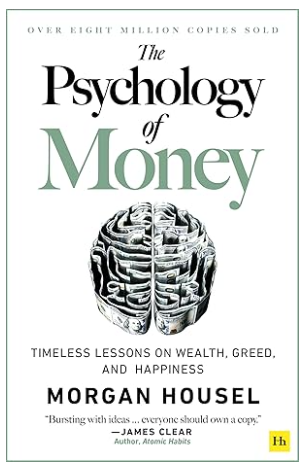
**OVER 8 MILLION COPIES SOLD AROUND THE WORLD… The Psychology of Money is the original bestselling classic from the author of the new book, Same as Ever.**
Doing well with money isn’t necessarily about what you know. It’s about how you behave. And behavior is hard to teach, even to really smart people.
Money―investing, personal finance, and business decisions―is typically taught as a math-based field, where data and formulas tell us exactly what to do. But in the real world people don’t make financial decisions on a spreadsheet. They make them at the dinner table, or in a meeting room, where personal history, your own unique view of the world, ego, pride, marketing, and odd incentives are scrambled together.
In The Psychology of Money, award-winning author Morgan Housel shares 19 short stories exploring the different ways people think about money and teaches you how to make better sense of one of life’s most important topics.