Is Bitcoin the New Tulip? 3 Warning Signs from 1637
Look at the price chart of Tulip bulbs in 1636-1637. Now, look at the chart of Bitcoin in 2017. Or NFTs in 2021. Or dot-com stocks in 1999.
The shape is identical. A vertical rise, a plateau of euphoria, and a devastating crash.
Whenever a new asset class explodes in value, critics scream “Tulips!” and believers scream “New Paradigm!” But who is right?
In our latest documentary, we traveled back 400 years to find the answer. It turns out, the Dutch didn’t just invent the stock market; they invented the Psychology of the Bubble. Here are the 3 warning signs that history is about to repeat itself.
1. The “New Technology” Narrative
Every bubble starts with a grain of truth.
- In 2000, the internet did change the world. But that didn’t save Pets.com from going to zero.
- In 2024, AI is revolutionary. But that doesn’t mean every AI startup is worth billions.

In 1637, the “new technology” was the Broken Tulip. The rare, multicolored patterns on the petals were seen as a biological miracle—a breakthrough in nature. People didn’t understand it (it was actually a virus), but they threw money at it because it was new and scarce.
The Lesson: Just because the technology is real, doesn’t mean the price is rational. Innovation often leads to a bubble before it leads to productivity.
2. The Trap of Leverage (Buying Air)
The Dutch called it Windhandel—”The Wind Trade.” Why? Because people were buying and selling bulbs that were still buried in the ground, months away from blooming.
Crucially, they didn’t pay cash. They paid a small deposit (often just “wine money” for the tavern). This was the invention of Derivatives and Margin Trading.
Today, we see the exact same mechanism in crypto exchanges offering 100x leverage.
- Leverage is a drug. On the way up, it makes you feel like a genius.
- On the way down, it wipes you out instantly.
When the 1637 market turned, the “paper profits” evaporated because nobody had the actual cash to settle the debts.

3. The “This Time Is Different” Fallacy
Sir John Templeton famously said, “The four most dangerous words in investing are: This time is different.”
In 1637, the Dutch believed that tulips would never go down because “foreign kings and rich merchants will always want them.” In 2008, bankers believed housing would never go down because “everybody needs a home.” In 2025, crypto investors believe “institutional adoption” will prevent a crash.
The asset class changes. The arguments change. But Human Nature never changes. Greed, fear, and the herd mentality are constant biological traits.
Conclusion: How to Survive
You don’t have to avoid new technology. You just have to respect gravity.
If you are investing because you understand the tech and have a 10-year horizon, you are an Investor. If you are investing because you think you can sell it to someone else for 2x next week, you are a Speculator playing the Greater Fool game. And eventually, the music stops.
Recommended Reading
1- This Time Is Different: Eight Centuries of Financial Folly
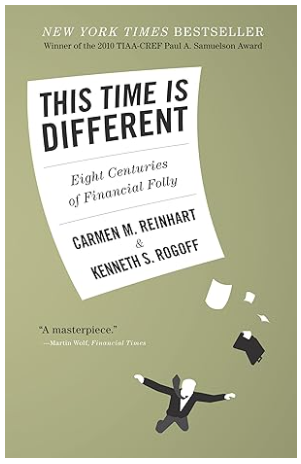
The acclaimed New York Times bestselling history of financial crises
Throughout history, rich and poor countries alike have been lending, borrowing, crashing, and recovering their way through an extraordinary range of financial crises. Each time, the experts have chimed, “this time is different”—claiming that the old rules of valuation no longer apply and that the new situation bears little similarity to past disasters. With this breakthrough study, leading economists Carmen Reinhart and Kenneth Rogoff definitively prove them wrong.
Covering sixty-six countries across five continents and eight centuries, This Time Is Different presents a comprehensive look at the varieties of financial crises—including government defaults, banking panics, and inflationary spikes—from medieval currency debasements to the subprime mortgage catastrophe. Reinhart and Rogoff provocatively argue that financial combustions are universal rites of passage for emerging and established market nations.
A remarkable history of financial folly, This Time Is Different will influence financial and economic thinking and policy for decades to come.
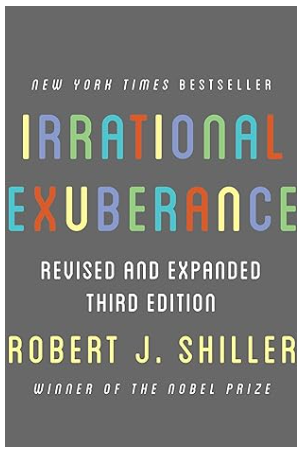
2- Irrational Exuberance – Robert J. Shiller
Why the irrational exuberance of investors hasn’t disappeared since the financial crisis
In this revised, updated, and expanded edition of his New York Times bestseller, Nobel Prize–winning economist Robert Shiller, who warned of both the tech and housing bubbles, cautions that signs of irrational exuberance among investors have only increased since the 2008–9 financial crisis. With high stock and bond prices and the rising cost of housing, the post-subprime boom may well turn out to be another illustration of Shiller’s influential argument that psychologically driven volatility is an inherent characteristic of all asset markets. In other words, Irrational Exuberance is as relevant as ever. Previous editions covered the stock and housing markets―and famously predicted their crashes. This edition expands its coverage to include the bond market, so that the book now addresses all of the major investment markets. It also includes updated data throughout, as well as Shiller’s 2013 Nobel Prize lecture, which places the book in broader context. In addition to diagnosing the causes of asset bubbles, Irrational Exuberance recommends urgent policy changes to lessen their likelihood and severity―and suggests ways that individuals can decrease their risk before the next bubble bursts. No one whose future depends on a retirement account, a house, or other investments can afford not to read this book.