Why Your Brain Hates Losing Money (And How It Costs You Millions)
Imagine I offer you a coin toss bet. If it’s tails, you lose $100. If it’s heads, you win $150.
Mathematically, you should take this bet every time. The potential gain significantly outweighs the loss. Yet, if you are like most people, you will reject it. Why?
Because in your brain, losing $100 hurts twice as much as winning $150 feels good.
This cognitive bias is called Loss Aversion, and it is the single biggest psychological barrier standing between you and financial freedom. In this article, we’ll explore how this ancient survival instinct is sabotaging your modern investment portfolio.

1. The Science of Pain: Why We Panic Sell
Loss Aversion was first identified by psychologists Daniel Kahneman and Amos Tversky. Their research revealed a startling truth: the pain of losing is psychologicaly about twice as powerful as the pleasure of gaining.
This evolutionary trait kept our ancestors alive. In the wild, avoiding a predator (loss of life) was far more important than finding extra berries (gain of food). But in the stock market, this instinct is a disaster. It leads to two common financial mistakes:
- Panic Selling: When the market dips 10%, your brain screams “DANGER!” and forces you to sell at a loss to stop the pain, causing you to miss the eventual recovery.
- The Disposition Effect: You hold onto losing investments for too long (hoping they break even) while selling winning investments too early (to secure a small win).
“The investor’s chief problem—and even his worst enemy—is likely to be himself.” — Benjamin Graham
2. The “Safe” Path is the Riskiest Path
Loss Aversion convinces us that keeping money in a savings account is “safe” because the number never goes down. But this ignores the silent killer: Inflation.
Let’s look at the math of “safety”:
- If you kept $10,000 in cash during a period of 5% inflation, you effectively lost $500 in purchasing power in just one year.
- You didn’t see the number drop, so your brain didn’t register the pain. But the loss was real.
To build wealth, you must train your mind to accept Volatility (temporary ups and downs) as the price of admission for Growth.

3. How to Hack Your Brain for Wealth
You cannot delete your biology, but you can manage it. Here is the Mind Be More protocol for overcoming Loss Aversion:
A. The “Overnight Test”
If you are worried about a losing investment, ask yourself: “If I sold this today and had the cash in my hand, would I buy this asset again right now?” If the answer is no, you are only holding it because of Loss Aversion. Sell it and move on.
B. Zoom Out
Loss Aversion thrives on short-term data. Stop checking your portfolio daily. The market is a voting machine in the short run (emotional), but a weighing machine in the long run (logical).
- Daily Check: High anxiety, high chance of seeing red.
- Yearly Check: Low anxiety, high chance of seeing green.
C. Automate Your Investing
Remove your emotions from the equation. Set up automatic monthly transfers to your investment accounts. When the decision is automatic, your brain doesn’t have time to feel fear.
Conclusion: The Cost of Comfort
Becoming wealthy requires a shift in identity. You must move from being a Saver (driven by fear of loss) to being an Investor (driven by rational growth).
The pain of short-term volatility is uncomfortable, but the pain of long-term regret is permanent. Choose your pain wisely.
Are you letting fear dictate your financial future? Share your thoughts in the comments below.
Further Reading
Thinking, Fast and Slow by Daniel Kahneman
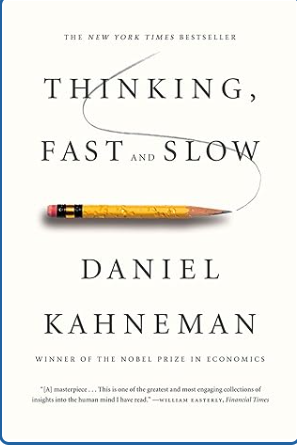
*Major New York Times Bestseller
*More than 2.6 million copies sold
*One of The New York Times Book Review’s ten best books of the year
*Selected by The Wall Street Journal as one of the best nonfiction books of the year
*Presidential Medal of Freedom Recipient
*Daniel Kahneman’s work with Amos Tversky is the subject of Michael Lewis’s best-selling The Undoing Project: A Friendship That Changed Our Minds
In his mega bestseller, Thinking, Fast and Slow, Daniel Kahneman, world-famous psychologist and winner of the Nobel Prize in Economics, takes us on a groundbreaking tour of the mind and explains the two systems that drive the way we think.
System 1 is fast, intuitive, and emotional; System 2 is slower, more deliberative, and more logical. The impact of overconfidence on corporate strategies, the difficulties of predicting what will make us happy in the future, the profound effect of cognitive biases on everything from playing the stock market to planning our next vacation―each of these can be understood only by knowing how the two systems shape our judgments and decisions.
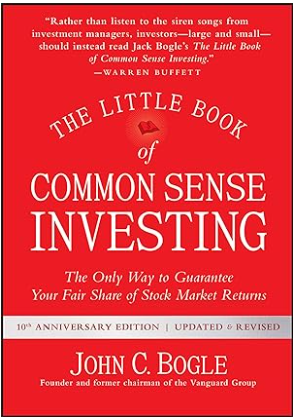
The Little Book of Common Sense Investing by John C. Bogle
The best-selling investing “bible” offers new information, new insights, and new perspectives
The Little Book of Common Sense Investing is the classic guide to getting smart about the market. Legendary mutual fund pioneer John C. Bogle reveals his key to getting more out of investing: low-cost index funds. Bogle describes the simplest and most effective investment strategy for building wealth over the long term: buy and hold, at very low cost, a mutual fund that tracks a broad stock market Index such as the S&P 500.
While the stock market has tumbled and then soared since the first edition of Little Book of Common Sense was published in April 2007, Bogle’s investment principles have endured and served investors well. This tenth anniversary edition includes updated data and new information but maintains the same long-term perspective as in its predecessor.
Bogle has also added two new chapters designed to provide further guidance to investors: one on asset allocation, the other on retirement investing.
A portfolio focused on index funds is the only investment that effectively guarantees your fair share of stock market returns. This strategy is favored by Warren Buffett, who said this about Bogle: “If a statue is ever erected to honor the person who has done the most for American investors, the hands-down choice should be Jack Bogle. For decades, Jack has urged investors to invest in ultra-low-cost index funds. Today, however, he has the satisfaction of knowing that he helped millions of investors realize far better returns on their savings than they otherwise would have earned. He is a hero to them and to me.”